
Industrial heaters are not selected only by voltage and wattage. A heater rated at 1,000 W can behave very differently from another 1,000 W heater depending on its size, heated surface area, application and heat-transfer conditions.
One of the most important specifications behind this difference is watt density.
Watt density helps engineers understand how much electrical power is being converted into heat over a given heating surface. Selecting an unsuitable watt density can contribute to excessive surface temperature, poor heat transfer, shortened heater life or inadequate heating performance.
In this guide, we explain what watt density means, how to calculate it, why it matters, and how engineers can use it when selecting industrial heating elements.
What Is Watt Density in a Heater?
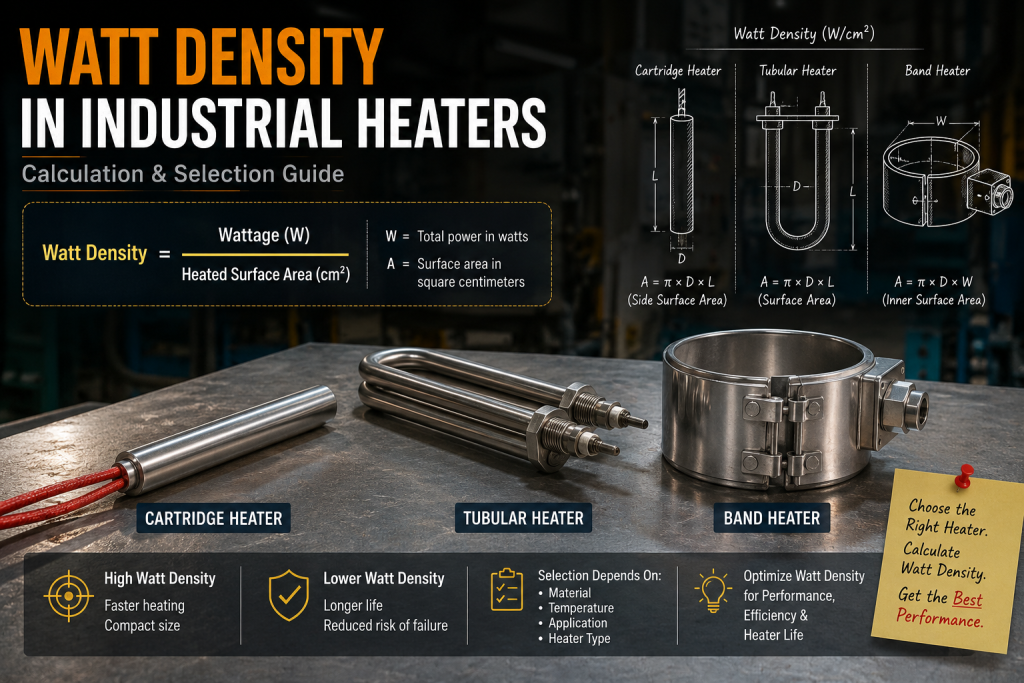
Watt density is the amount of heating power generated over a unit of heater surface area. It is commonly expressed in W/cm² or W/in². For a cartridge heater, it can be calculated by dividing the heater’s wattage by the effective heated surface area. A higher watt density concentrates more heat into a smaller area, while a lower watt density distributes the same power over a larger surface.
What Does Watt Density Mean?
Watt density describes the surface loading of a heating element.
In simple terms:
Watt density = how much power is concentrated on the heating surface.
Consider two heaters:
- Heater A = 1,000 W
- Heater B = 1,000 W
If Heater A has a much smaller heated surface area than Heater B, Heater A will have a higher watt density.
Therefore, wattage alone does not tell you how aggressively a heater is loading its surface.
This is particularly important for compact heaters such as cartridge heaters, where heat must transfer efficiently from the heater sheath into a mould, die, plate or other heated component.
Why Is Watt Density Important?
Watt density affects several aspects of industrial heater performance.
1. Heat Transfer
A properly selected watt density helps the heater transfer the required heat to the application without creating excessive surface temperature.
2. Heat-Up Time
Higher watt density can provide concentrated heating and faster heat-up in applications designed to accommodate it.
However, simply increasing watt density is not always the correct way to reduce heating time.
3. Heater Surface Temperature
As watt density increases, the heater may operate with a higher surface loading.
The actual surface temperature depends on factors such as:
- Material being heated
- Contact between heater and component
- Operating temperature
- Heat loss
- Heater construction
- Airflow
- Installation
- Temperature control
4. Heater Service Life
An improperly selected watt density can contribute to overheating and premature failure.
For cartridge heaters, technical manufacturers specifically identify excessive watt density and poor heat dissipation as possible causes of failure.
5. Temperature Uniformity
A suitable watt density combined with proper heater placement can help achieve more uniform heating.
How Is Heater Watt Density Calculated?
The general concept is:
Watt Density = Heater Wattage ÷ Heated Surface Area
For a cylindrical cartridge heater, the heated surface area can be approximated as:
Heated Surface Area = π × Diameter × Heated Length
Therefore:
Watt Density = W ÷ (π × D × L)
Where:
- W = heater wattage
- D = heater diameter
- L = effective heated length
- π = approximately 3.1416
For cartridge heaters, it is important to use the heated length, not automatically the complete physical length. Some heater constructions include unheated sections at the ends.
Watt Density Calculation Example
Suppose a cartridge heater has:
- Power = 1,000 W
- Diameter = 12 mm
- Heated length = 100 mm
Convert the dimensions to centimetres:
- Diameter = 1.2 cm
- Heated length = 10 cm
Surface area:
3.1416 × 1.2 × 10 = approximately 37.7 cm²
Therefore:
Watt density = 1,000 ÷ 37.7
Watt density ≈ 26.5 W/cm²
This number can then be evaluated against the application’s temperature, material, heat-transfer conditions, installation fit and heater construction.
It should not be interpreted as a universally acceptable watt density for every application.
W/cm² vs W/in²: What’s the Difference?
Watt density is commonly expressed in either:
- W/cm²
- W/in²
They describe the same physical concept using different units.
Approximately:
1 W/in² = 0.155 W/cm²
and:
1 W/cm² = 6.45 W/in²
Always confirm the unit before comparing specifications from different manufacturers.
A value that looks small in W/cm² can look much larger when expressed in W/in².
High Watt Density vs Low Watt Density
| Parameter | Lower Watt Density | Higher Watt Density |
|---|---|---|
| Power concentration | Lower | Higher |
| Heat concentration | More distributed | More concentrated |
| Potential heat-up | Generally slower | Potentially faster |
| Surface loading | Lower | Higher |
| Heat-transfer demand | Generally lower | Generally higher |
| Application sensitivity | Lower in many cases | Higher |
| Heater selection | Often suitable for gentler heating | Requires careful application evaluation |
| Service-life considerations | Can be favourable when correctly selected | Requires proper heat dissipation and installation |
This table is a general engineering comparison, not a universal rule. The appropriate value depends on the complete heating system.
What Happens If Watt Density Is Too High?
Excessive watt density can create problems when the application cannot remove heat from the heater fast enough.
Possible consequences include:
Excessive heater temperature
The heater surface may become significantly hotter than the target material or component.
Localised overheating
Poor contact or uneven installation can create hot spots.
Premature heater failure
Excessive thermal loading can shorten service life.
Material damage
Some applications involve plastics, oils, coatings, adhesives or other materials that can degrade if exposed to excessive local temperatures.
Poor temperature control
A heater that is too aggressive for the application may cycle rapidly or create temperature overshoot.
Does Higher Watt Density Always Mean Faster Heating?
No.
Higher watt density does not automatically guarantee faster or better heating.
Overall heat-up performance also depends on:
- Total heater wattage
- Mass of the material
- Specific heat
- Starting temperature
- Target temperature
- Heat losses
- Insulation
- Contact area
- Heater placement
- Thermal conductivity
- Airflow or fluid movement
- Temperature-control system
For example, increasing heater watt density without improving heat transfer may increase heater surface temperature without proportionally improving the temperature of the workpiece.
The objective should therefore be appropriate watt density, not simply the highest possible value.
Watt Density in Cartridge Heaters
Watt density is particularly important for cartridge heaters because they are commonly installed inside drilled holes in moulds, dies, plates and other metal components.
Technical heater guidance notes that proper fit between the cartridge and its hole is important for heat transfer, especially at higher watt densities.
A cartridge heater therefore needs to be evaluated together with:
- Diameter
- Heated length
- Wattage
- Voltage
- Hole diameter
- Hole depth
- Operating temperature
- Workpiece material
- Fit/tolerance
- Heat-transfer requirements
- Installation orientation
- Temperature sensor location
A heater specification should never be selected based on watt density alone.
Watt Density and Heater Failure
When an industrial heater fails repeatedly, replacing it with another heater having the same wattage may not solve the underlying problem.
The actual issue could be:
- Excessive watt density
- Poor heater-to-workpiece contact
- Incorrect hole dimensions
- Incorrect voltage
- Poor temperature control
- Insufficient heat dissipation
- Moisture ingress
- Contamination
- Loose electrical connections
- Incorrect heater placement
- Operating outside the intended temperature range
For cartridge heaters, improper fit and excessive watt density are recognised failure considerations.
This is why troubleshooting should examine the entire heating application, rather than only the failed component.
How to Choose the Right Watt Density
There is no single watt-density value that works for every industrial heater.
A practical selection process should begin with the application.
1. Identify the Material Being Heated
Determine whether you are heating:
- Steel
- Aluminium
- Plastic
- Oil
- Water
- Chemical solution
- Air
- Gas
- Food product
- Adhesive
- Another process material
Different materials transfer and absorb heat differently.
2. Define the Required Temperature
Determine:
- Starting temperature
- Operating temperature
- Maximum temperature
- Required heat-up time
The heater should be selected based on the actual process rather than simply choosing the highest available rating.
3. Calculate Required Heating Power
Consider the mass being heated and the required temperature increase.
For many applications, the basic energy relationship begins with:
Q = m × Cp × ΔT
Where:
- Q = required thermal energy
- m = mass
- Cp = specific heat
- ΔT = temperature change
Real systems must also account for heat losses and the desired heat-up time.
4. Determine Available Installation Space
Check:
- Heater diameter
- Heater length
- Number of heaters
- Hole dimensions
- Available surface area
- Clearance
- Electrical connection space
A smaller heater with the same wattage can produce a higher watt density.
5. Evaluate Heat Transfer
Ask how efficiently heat can move from the heater to the material.
For example:
- A cartridge heater tightly fitted into a properly manufactured hole can transfer heat differently from a heater with excessive clearance.
- A tubular heater immersed in liquid behaves differently from one heating air.
- A band heater depends strongly on contact with the barrel surface.
6. Consider the Heater Sheath Material
The sheath material should suit the operating environment.
Depending on the application, industrial heaters may use materials such as:
- Stainless steel
- Incoloy
- Other application-specific alloys
Material selection should consider temperature, corrosion, mechanical conditions and the heating medium.
7. Select the Heater Wattage and Geometry Together
Do not select:
“I need 2 kW, so give me any 2 kW heater.”
Instead define:
2 kW + voltage + heater type + diameter + heated length + operating temperature + application + material + installation conditions
This produces a much more useful engineering specification.
Important Heater Specifications to Provide to a Manufacturer
When requesting a quotation for a custom industrial heater, provide as much of the following information as possible:
Electrical
- Wattage
- Voltage
- Phase
- Frequency
- Connection type
Mechanical
- Diameter
- Length
- Width
- Shape
- Mounting arrangement
- Terminal arrangement
Thermal
- Required temperature
- Heating medium
- Heat-up time
- Continuous/intermittent operation
- Desired watt density, if already established
Application
- Machine name
- Material being heated
- Operating environment
- Installation position
- Available space
Control
- Thermocouple/RTD requirement
- Temperature controller
- PID control
- Over-temperature protection
This information allows the heater manufacturer to evaluate the application rather than simply matching a wattage.
Common Mistakes to Avoid
1. Selecting a Heater Only by Wattage
Two heaters with identical wattage can have significantly different watt densities.
Avoid it: Evaluate wattage, dimensions and application together.
2. Ignoring Heated Length
Using total heater length instead of effective heated length can produce an incorrect watt-density calculation.
Avoid it: Use the manufacturer’s effective heated length.
3. Using the Highest Watt Density Available
Maximum power concentration isn’t automatically the best solution.
Avoid it: Select according to the heat-transfer requirements of the application.
4. Ignoring Heater-to-Component Fit
Poor contact can restrict heat transfer.
Avoid it: Follow the heater manufacturer’s dimensional and installation recommendations.
5. Increasing Wattage to Fix Slow Heating
Slow heating may result from insulation, heat loss, poor contact or incorrect heater positioning.
Avoid it: Diagnose the complete thermal system first.
6. Ignoring Voltage
A heater must be designed for the intended electrical supply.
For a resistive heater, power is related to voltage and resistance. Changing the applied voltage can substantially change the power output.
Avoid it: Verify voltage before installation.
7. Ignoring Temperature Control
Even a correctly designed heater can produce poor process results without suitable temperature sensing and control.
Avoid it: Consider the complete control system.
8. Replacing a Failed Heater With an Identical Specification Without Investigation
Repeated failures may indicate an application problem rather than a manufacturing defect.
Avoid it: Check watt density, fit, temperature, voltage, heat transfer and operating conditions.
How Watt Density Relates to Heater Life
Watt density should be considered as one part of heater-life management.
Correct selection can help keep the heater within an appropriate operating range, but service life also depends on:
- Heater construction
- Sheath material
- Insulation
- Temperature
- Cycling frequency
- Heat transfer
- Installation
- Electrical supply
- Moisture
- Contamination
- Maintenance
Therefore, it would be incorrect to claim that a particular watt density automatically guarantees a specific heater lifespan.
The correct approach is to match the heater design to the process.
Can Watt Density Be Reduced?
Yes, depending on the heater design and application.
One common approach is to increase the effective heated surface area while maintaining the required total wattage.
For example, if the required power remains constant but the heater has a larger heated surface area, the power is distributed over a greater area.
Other design options can include:
- Increasing heater length
- Increasing diameter
- Using multiple heaters
- Redesigning heater geometry
- Adjusting wattage distribution
- Improving heat transfer
The correct solution depends on the equipment and process.
Watt Density Should Be Considered With the Complete Heating System
Watt density is important, but it is only one part of heater engineering.
A reliable industrial heating system considers:
Power → Watt Density → Heat Transfer → Temperature → Control → Installation → Material → Duty Cycle
Ignoring any one of these factors can result in poor performance.
For example, a heater with an apparently suitable watt density can still fail prematurely if it is installed incorrectly or operated at an unsuitable voltage.
Industrial Heating Solutions from Antique Heating Elements
Antique Heating Elements manufactures industrial heating solutions for applications across industries including plastics, packaging, food processing and manufacturing.
The company’s industrial heater range includes solutions such as tubular heaters, cartridge heaters, band heaters, coil heaters, finned heaters, casted heaters, immersion heaters, air heaters and other application-specific heating elements.
For a custom heater requirement, buyers can share the application details, required wattage, voltage, dimensions, operating temperature, material being heated and installation conditions.
AHE can then evaluate the requirements and develop a suitable heater configuration rather than relying only on a standard wattage.
Need a custom industrial heater? Share your heater dimensions, voltage, wattage and application requirements with the AHE technical team to discuss a suitable configuration.
Conclusion
Watt density is an important specification for industrial heating elements because it describes how concentrated the heating power is over the heater’s active surface.
However, higher watt density is not automatically better.
The right selection depends on the application, heat-transfer conditions, operating temperature, material, heater geometry, installation and control system.
For industrial buyers, the most reliable approach is to specify the complete heating requirement rather than selecting a heater only by wattage.
FAQ Section
What is watt density in a heater?
Watt density is the amount of electrical heating power generated per unit of heater surface area. It is commonly expressed in W/cm² or W/in². A higher watt density means more power is concentrated over a given heating surface.
How do you calculate heater watt density?
For a cylindrical heater, watt density can be calculated by dividing heater wattage by the effective heated surface area. For a cartridge heater, the basic formula is W ÷ (π × diameter × heated length). Always use the manufacturer’s effective heated length when applicable.
Why is watt density important?
Watt density influences heat concentration, heater surface loading, heat transfer and potentially heater life. Incorrect selection can contribute to overheating, inadequate heat transfer or premature failure.
Is higher watt density better?
Not necessarily. Higher watt density can be useful when an application requires concentrated heating and has adequate heat transfer, but excessive loading can create thermal problems. The appropriate value depends on the complete application.
What is the difference between W/cm² and W/in²?
Both are units used to express watt density. W/in² uses square inches while W/cm² uses square centimetres. Approximately 1 W/in² = 0.155 W/cm².
How does watt density affect cartridge heater life?
If watt density is excessive for the application, the heater may experience higher thermal loading and inadequate heat dissipation, which can contribute to premature failure. Proper fit and heat transfer are also important.
What information is required to select a cartridge heater?
Important information includes wattage, voltage, diameter, heated length, installation dimensions, operating temperature, workpiece material, heat-up time, duty cycle and terminal/lead requirements.
Can two heaters with the same wattage have different watt densities?
Yes. If their heated surface areas are different, their watt densities will also be different. A smaller heater generally concentrates the same wattage over a smaller surface.
Does watt density affect heating speed?
It can, but watt density alone does not determine heat-up speed. Total power, thermal mass, heat losses, heat transfer, insulation, heater placement and temperature control also influence the result.
What causes cartridge heaters to fail?
Potential causes include excessive watt density, poor fit, inadequate heat transfer, moisture, contamination, incorrect voltage and unsuitable operating conditions. Repeated failures should be investigated rather than simply replacing the heater.
Can AHE manufacture custom industrial heaters?
Yes. AHE’s industrial heater offering includes multiple heater types and custom configurations for industrial applications. Requirements such as wattage, voltage, dimensions, materials and application conditions should be provided for proper heater selection.
