
Choosing the right heating element for an industrial air-heating application can have a significant impact on heat-transfer performance, temperature uniformity, energy use and heater life.
Two commonly used options are tubular heaters and finned heaters. Both are based on tubular heating elements, but their construction and heat-transfer characteristics are different.
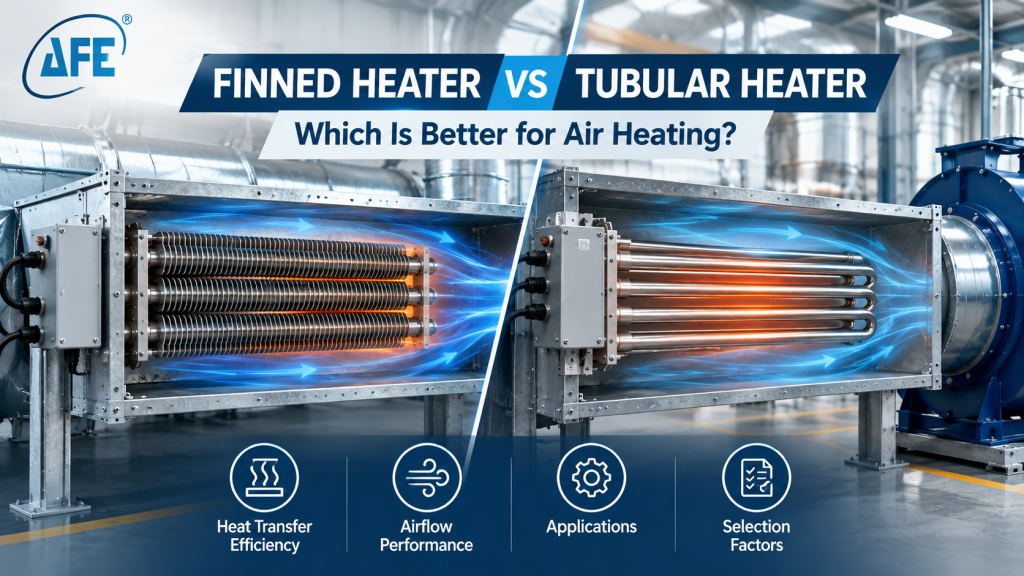
A standard tubular heater is a versatile heating element that can be used for air, liquids, oils, surfaces and many industrial processes. A finned heater adds metal fins around the tubular element to increase the available heat-transfer surface, making it particularly useful for forced-air and duct-heating applications. AHE currently offers both tubular and finned heaters for industrial applications.
So, which one is better for air heating?
For applications involving continuous or forced airflow, a finned heater is often the more suitable choice because its extended surface area improves heat transfer to moving air. However, a standard tubular heater can be appropriate when the application has different space, temperature, mounting or process requirements.
This guide explains the difference between finned and standard tubular heaters and how to select the right option.
What Is a Tubular Heater?
A tubular heater is an electric heating element constructed around a resistance wire insulated with high-purity magnesium oxide and enclosed in a metal sheath.
Tubular heaters can be manufactured in different lengths, diameters and shapes depending on the application.
They are used for:
- Air heating
- Liquid heating
- Oil heating
- Ovens
- Drying systems
- Industrial machinery
- Immersion heating
- Surface heating
- Process heating
AHE’s tubular heaters are available in materials including SS304, SS316 and Incoloy, depending on application requirements.
Their versatility is one of the main reasons tubular heating elements are widely used in industrial heating systems.
What Is a Finned Heater?
A finned heater is essentially a tubular heating element fitted with metal fins around its sheath.
These fins increase the effective heat-transfer surface area available to the surrounding air.
The basic principle is simple:
More effective surface area → greater heat transfer to moving air
Finned heaters are therefore particularly suitable for applications where air or gas flows across the heating element.
Typical applications include:
- Air heaters
- Duct heaters
- HVAC systems
- Drying ovens
- Industrial dryers
- Ventilation systems
- Air-handling equipment
- Process-air heating
AHE describes its finned heaters as being designed for air, gas and duct-heating applications.
Finned Heater vs Tubular Heater: Key Difference
The main difference is the heat-transfer surface area.
A standard tubular heater has a smooth metal sheath.
A finned heater has additional fins attached around the tubular element.
These fins increase the surface area available for transferring heat to moving air.
| Feature | Tubular Heater | Finned Heater |
| Basic construction | Smooth tubular element | Tubular element with fins |
| Heat-transfer surface | Standard | Increased |
| Air heating | Suitable | Highly suitable |
| Forced-air systems | Suitable depending on design | Particularly suitable |
| Duct heating | Suitable | Highly suitable |
| Liquid heating | Suitable | Generally not the primary configuration |
| Compact air heating | Moderate | Excellent |
| Heat dissipation to airflow | Standard | Enhanced |
| Custom shapes | Available | Available depending on design |
| Typical applications | Air, liquid, oil, ovens, machinery | Air, ducts, dryers, HVAC |
The important point is that finned does not automatically mean better for every heating application.
The correct heater depends on the heating medium and process conditions.
Why Are Fins Used on Heating Elements?
Air has relatively low thermal conductivity compared with liquids, so transferring heat efficiently from a heating element to moving air can require an appropriate surface area and airflow arrangement.
Adding fins increases the surface area exposed to the airflow.
This can help the heating element transfer heat more effectively to passing air.
A finned tubular heater can therefore be particularly useful when:
- Air is continuously moving
- A large volume of air needs to be heated
- The heater is installed inside a duct
- A blower is used
- Fast heat transfer is required
- The available heater installation space is limited
AHE’s air-heater range includes tubular and finned heating elements for applications such as HVAC, drying, food processing, pharmaceutical, packaging and chemical systems.
When Should You Choose a Tubular Heater?
A standard tubular heater may be the better choice when the application requires versatility rather than specifically maximising air-side heat transfer.
Tubular heaters can be used for:
1. General Air Heating
Tubular heaters can be incorporated into air-heating equipment where the airflow and heat-transfer requirements are compatible with the element design.
2. Liquid Heating
Tubular heaters are widely used for heating:
- Water
- Oil
- Chemicals
- Process liquids
3. Immersion Applications
Tubular elements can be formed into suitable shapes for immersion heating.
4. Industrial Ovens
Tubular elements can be installed in ovens and heating chambers depending on the airflow and temperature requirements.
5. Custom Machinery
Tubular heaters can be bent and formed into different configurations to suit equipment geometry.
AHE’s tubular-heater range includes straight, U-shaped and custom-formed configurations for different industrial applications.
When Should You Choose a Finned Heater?
A finned heater becomes particularly attractive when the primary heating medium is moving air or gas.
Typical applications include:
Duct Heating
Finned heaters can be installed inside air ducts where heated air must move continuously through the system.
Industrial Dryers
They can be used to heat air circulating through drying chambers.
HVAC Systems
Finned heating elements can be integrated into air-handling and ventilation systems.
Process Air Heating
Industries may require controlled hot air for drying, curing or other manufacturing processes.
Hot Air Systems
Finned elements can be incorporated into air-heating systems that use blowers to circulate heated air.
AHE’s duct-heater range specifically uses tubular heating elements and optional finned designs for HVAC, drying, food processing, pharmaceutical and chemical applications.
Finned Heater vs Tubular Heater for Air Heating
If the application is specifically air heating, the decision should be based on airflow, temperature, available space, required heating capacity and installation design.
Finned Heater
Best suited when:
- Air is moving continuously
- Forced convection is used
- The heater is installed in a duct
- High heat transfer is required
- A compact heating assembly is desirable
- A blower or air-handling system is present
Standard Tubular Heater
Can be suitable when:
- Airflow is lower
- The heater has sufficient exposed surface
- The application has unique mounting requirements
- A custom shape is required
- The same heater design may also be used for other heating applications
Therefore:
For many forced-air and duct-heating applications, a finned heater is generally the preferred configuration.
However, the final selection should be based on the actual thermal and airflow conditions rather than the heater type alone.
Does a Finned Heater Heat Air Faster?
A finned heater can provide more effective heat transfer to moving air because the fins increase the available surface area.
However, heating speed does not depend only on the heater construction.
It also depends on:
- Heater wattage
- Airflow rate
- Air inlet temperature
- Required outlet temperature
- Air velocity
- Heater surface temperature
- Number of heating elements
- Duct dimensions
- Insulation
- Heat losses
For this reason, simply replacing a tubular heater with a finned heater does not automatically guarantee a specific temperature increase or heating time.
The complete air-heating system needs to be evaluated.
How Airflow Affects Heater Selection
Airflow is one of the most important parameters when selecting an air heater.
You should know:
- Airflow rate
- Air velocity
- Inlet air temperature
- Required outlet temperature
- Operating pressure
- Available duct dimensions
- Required heating capacity
A heater designed for a low-airflow system may not be suitable for a high-volume forced-air system.
Similarly, an element operating without sufficient airflow can experience excessive temperatures.
Why Watt Density Matters
Watt density is another important factor when selecting a heating element.
It describes the amount of electrical power applied over the active heating surface.
For air-heating applications, the relationship between watt density and airflow needs to be considered carefully.
Your existing AHE article on Watt Density in Industrial Heaters should be linked here because it provides the detailed explanation of watt density, calculation and heater selection.
The selection chain is:
Airflow → Heat Requirement → Heater Wattage → Surface Area → Watt Density → Heater Configuration
This is more useful than choosing a heater solely by total wattage.
How to Select a Finned Heater for Air Heating
Before ordering a finned heater, collect the following information.
1. Airflow
Specify the airflow rate, such as:
- m³/h
- CFM
- m³/s
2. Air Inlet Temperature
What is the temperature of the air entering the heater?
3. Required Outlet Temperature
What temperature should the air reach after passing through the heater?
4. Required Heating Capacity
Determine the required thermal power based on airflow and temperature rise.
5. Available Voltage
Specify:
- 230 V
- 415 V
- Single phase
- Three phase
or the actual electrical supply available at the installation.
6. Installation Dimensions
Provide:
- Heater length
- Duct dimensions
- Available clearance
- Element diameter
- Number of elements
- Mounting arrangement
7. Air Quality
The air may contain:
- Dust
- Moisture
- Chemicals
- Vapours
- Particles
These environmental conditions can influence material selection and heater construction.
8. Operating Temperature
Specify both normal and maximum operating temperatures.
How to Select a Tubular Heater for Air Heating
For a tubular heater used in an air-heating system, consider:
- Required wattage
- Voltage
- Tube diameter
- Heater length
- Shape
- Airflow
- Operating temperature
- Sheath material
- Mounting method
- Heat-transfer requirements
- Control system
Custom-formed tubular heaters can be designed around equipment geometry where a standard straight element is unsuitable.
Finned Heater vs Tubular Heater: Which Is More Energy Efficient?
It would be incorrect to say that one heater is universally more energy efficient.
Both are electrical resistance heaters, so their electrical energy consumption is primarily related to their power rating and operating time.
The difference is more about how effectively the generated heat is transferred to the air.
A properly designed finned heater can improve heat transfer in forced-air systems because of its increased surface area.
Better heat transfer can help the system achieve the required air temperature without unnecessarily increasing the heater surface temperature.
However, overall system efficiency also depends on:
- Insulation
- Airflow
- Heat losses
- Temperature control
- Heater sizing
- Duct design
- Operating cycle
Finned Heater vs Tubular Heater: Advantages and Disadvantages
Finned Heater Advantages
- Increased heat-transfer surface
- Well suited to forced-air heating
- Suitable for duct systems
- Useful for drying applications
- Compact heat-transfer arrangement
- Suitable for HVAC and process-air heating
Potential limitations
- Fins can accumulate dust in dirty environments
- Correct airflow is important
- Cleaning may require additional attention
- Not necessarily the right configuration for liquid immersion applications
Tubular Heater Advantages
- Highly versatile
- Suitable for air, liquid and oil heating
- Can be formed into different shapes
- Robust construction
- Suitable for many industrial applications
- Available in different sheath materials
Potential limitations
- Smooth elements have less surface area than finned designs of comparable length
- May require different configurations for high-volume forced-air applications
- Air-side heat transfer depends strongly on airflow and element arrangement
Applications Comparison
| Application | Recommended Starting Point |
| HVAC air heating | Finned heater / duct heater |
| Industrial duct heating | Finned heater |
| Forced-air drying | Finned heater |
| Hot air blower | Finned or tubular heating assembly |
| General oven heating | Tubular or finned depending on airflow |
| Water heating | Tubular heater |
| Oil heating | Tubular heater |
| Chemical immersion | Tubular/immersion configuration |
| Custom machinery | Tubular heater |
| Air handling unit | Finned/duct-heater configuration |
The final configuration should be selected from the actual process conditions.
Common Mistakes When Selecting Air Heating Elements
Choosing Only by Wattage
Two heaters with the same wattage can perform differently depending on airflow, surface area and installation.
Ignoring Airflow
A heater designed without considering airflow may not provide the desired outlet temperature.
Using Excessive Watt Density
Higher wattage is not automatically better. Surface temperature and heat transfer must be considered.
Ignoring Dust and Contamination
Industrial air may contain dust or particles that can accumulate around fins.
Ignoring Temperature Control
Air heaters should generally be integrated with appropriate temperature measurement and control.
Installing Without Adequate Airflow
The heater design should be compatible with the actual operating airflow and installation conditions.
Can a Finned Heater Replace a Tubular Heater?
Sometimes, but not always.
If the existing tubular heater is being used for forced-air heating and the system requires greater heat-transfer surface area, a finned configuration may be worth evaluating.
However, replacing the heater should not be based solely on physical dimensions or wattage.
The following should be reviewed:
- Wattage
- Voltage
- Airflow
- Temperature
- Heater dimensions
- Watt density
- Mounting
- Sheath material
- Control system
- Available clearance
For a custom replacement, provide the existing heater specifications and operating conditions to the manufacturer.
Finned Heater vs Tubular Heater: Final Verdict
So, which is better for air heating?
Choose a finned heater when:
Airflow is the main heating medium and efficient heat transfer to moving air is the priority.
Finned elements are particularly suitable for:
- Duct heaters
- HVAC systems
- Drying systems
- Forced-air heating
- Air-handling equipment
- Process-air heating
Choose a tubular heater when:
You need a versatile heating element that can be used across air, liquid, oil, surface or custom industrial applications.
The best heater is therefore not determined simply by whether it has fins.
It should be selected based on the airflow, temperature rise, wattage, watt density, installation dimensions, material and operating conditions.
Industrial Finned and Tubular Heater Solutions from AHE
Antique Heating Elements manufactures and supplies industrial finned heaters, tubular heaters and air-heating solutions for applications including HVAC, drying, packaging, food processing, pharmaceutical and chemical industries.
AHE’s air-heater solutions can be designed using tubular or finned heating elements according to the application requirements.
For a custom heater requirement, provide:
- Airflow
- Inlet temperature
- Required outlet temperature
- Wattage
- Voltage
- Heater dimensions
- Duct dimensions
- Mounting arrangement
- Material requirement
- Quantity
Need Help Selecting the Right Heater?
Share your airflow, temperature, voltage, wattage and installation dimensions with AHE for a suitable industrial air-heating solution.
Frequently Asked Questions
What is the difference between a finned heater and a tubular heater?
A finned heater is a tubular heating element fitted with metal fins to increase its heat-transfer surface area. A standard tubular heater has a smooth sheath. Finned heaters are particularly useful for moving-air applications.
Is a finned heater better than a tubular heater for air heating?
For many forced-air and duct-heating applications, finned heaters are a suitable choice because the fins increase the available heat-transfer surface. However, the correct choice depends on airflow, temperature, wattage and system design.
What is a finned tubular heater used for?
Finned tubular heaters are commonly used for air, gas and duct heating, including HVAC systems, drying ovens, air-handling equipment and industrial process-air systems.
Can tubular heaters be used for air heating?
Yes. Tubular heaters can be used for air heating as well as liquid, oil, surface and other industrial heating applications.
Do fins make a heater more efficient?
Fins increase the surface area available for heat transfer. This can improve heat transfer to moving air, but overall system efficiency also depends on airflow, insulation, heater sizing, temperature control and heat losses.
What information is needed to select a finned heater?
Important information includes airflow rate, inlet and outlet air temperatures, required heating capacity, voltage, dimensions, mounting arrangement, operating environment and quantity.
Can a finned heater be used in a duct?
Yes. Finned heating elements are commonly used in duct-heating and air-handling applications where air passes over the heated surfaces.
How does airflow affect a finned heater?
Airflow affects how quickly heat is removed from the heater surface and transferred into the air stream. Heater selection should therefore consider airflow rate and velocity.
Are finned heaters suitable for dusty environments?
They can be used in some industrial environments, but dust accumulation around fins should be considered because it can affect heat transfer and maintenance requirements. The actual environment should be evaluated before selecting the heater.
Can AHE manufacture custom finned heaters?
AHE provides custom-sized industrial heating solutions. Heater dimensions, wattage, voltage, materials and configuration can be specified according to the application requirements.
