
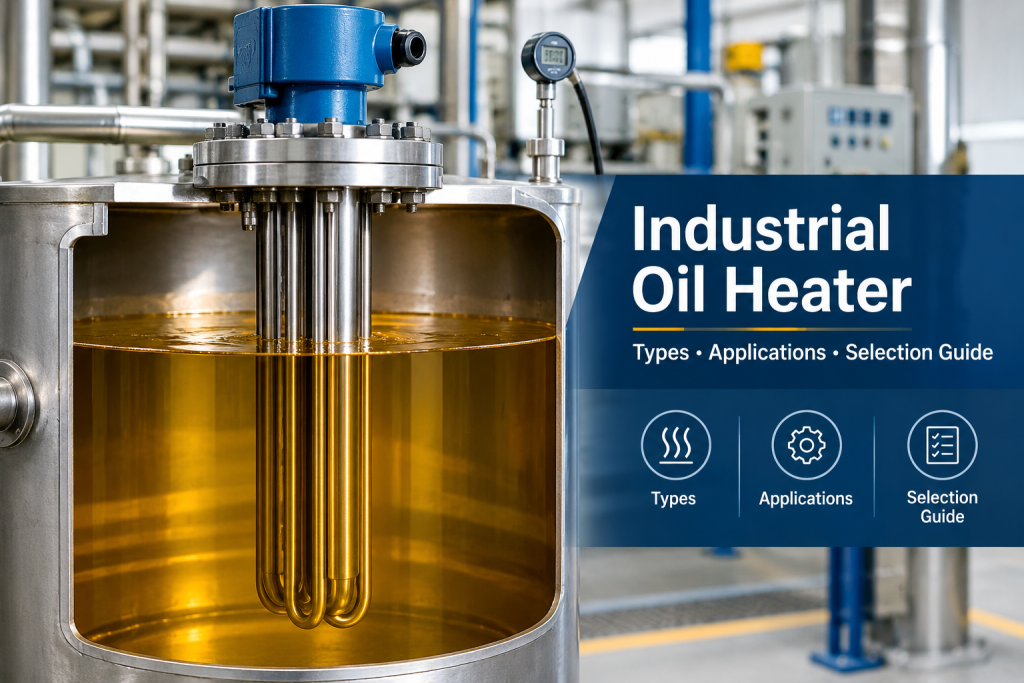
Industrial oils are used in hydraulic systems, lubrication systems, process equipment, machinery, chemical processing and many other applications. Maintaining the correct oil temperature is important because temperature affects viscosity, flow behaviour, lubrication performance and overall process stability.
An industrial oil heater is designed to heat oil or oil-based fluids to a required process temperature. Depending on the application, electric heating elements can be installed directly inside a tank or vessel, or incorporated into a suitable heating system.
Choosing an industrial oil heater is not simply a matter of selecting a particular wattage. The oil type, required temperature, tank dimensions, heat-up time, heater material, watt density, voltage, mounting arrangement and temperature-control method all need to be considered.
This guide explains the main types of industrial oil heaters, their applications and the important factors to consider before selecting one.
Quick Answer: What Is an Industrial Oil Heater?
An industrial oil heater is an electric heating device designed to raise and maintain the temperature of oil or compatible oil-based fluids used in industrial processes.
Common configurations include immersion-type heating elements installed directly in tanks or vessels. The appropriate heater depends on the oil characteristics, required temperature, tank size, heating time, wattage, watt density, heater material and operating conditions.
AHE currently lists industrial oil heaters for chemical, pharmaceutical and process industries as part of its industrial-heater range.
Why Is Oil Heating Important in Industry?
Oil viscosity changes with temperature.
When oil becomes too cold, it can become more viscous and may not flow or circulate as required. This can affect pumping, lubrication and heat transfer.
Controlled heating may therefore be required to:
- Maintain suitable oil viscosity
- Improve oil circulation
- Maintain process temperature
- Reduce cold-start problems
- Keep hydraulic fluids within the required operating range
- Heat process oils in tanks and vessels
- Maintain lubrication-oil temperature
- Support consistent industrial processes
The exact temperature requirement depends on the type of oil and the application.
Types of Industrial Oil Heaters
There is no single heater configuration suitable for every oil-heating application.
The heater arrangement should be selected according to the oil, vessel, temperature and process requirements.
1. Oil Immersion Heaters
Oil immersion heaters are installed directly into an oil tank, reservoir or process vessel.
The heating elements transfer heat directly to the surrounding oil.
Typical construction can include tubular heating elements mounted to a flange or other suitable connection.
Applications include:
- Oil storage tanks
- Hydraulic oil reservoirs
- Lubricating-oil systems
- Process tanks
- Industrial machinery
- Chemical processing
- Oil circulation systems
Direct immersion provides a straightforward method of transferring electrical heating power into the oil.
However, the heater must be properly designed for the particular oil and operating conditions.
2. Flanged Oil Heaters
Flanged heaters use a flange-mounted assembly that can be installed through a tank or vessel opening.
This configuration is useful where:
- Higher heating capacity is required
- The heater needs to be removable
- A tank already has a flange connection
- Multiple heating elements are required
- Maintenance access is important
The flange, sheath material, element arrangement and terminal enclosure should be selected according to the process conditions.
3. Screw-Plug Oil Heaters
Screw-plug heaters use a threaded mounting arrangement.
They can be useful for smaller tanks, reservoirs and equipment where a suitable threaded connection is available.
Selection considerations include:
- Thread size
- Heater length
- Wattage
- Voltage
- Oil temperature
- Material compatibility
- Available installation space
For larger industrial systems, a flanged configuration may be more appropriate.
4. Circulation-Based Oil Heating Systems
Some industrial processes heat oil indirectly or through a circulation system.
In these applications, heated oil is circulated through the equipment or process requiring heat.
The heater arrangement depends on the overall system design.
Important considerations include:
- Oil flow rate
- Required outlet temperature
- Inlet temperature
- Heater capacity
- Pressure
- Pump characteristics
- Temperature control
- System heat losses
The heating element should therefore be designed as part of the complete heating system rather than selected only on the basis of wattage.
Where Are Industrial Oil Heaters Used?
Industrial oil heaters are used in a wide range of applications where controlled oil temperature is required.
1. Hydraulic Oil Heating
Hydraulic systems may require oil to remain within a suitable operating temperature range.
An oil heater can be used to warm hydraulic fluid when low ambient temperatures or process conditions cause the oil to become too viscous.
Applications may include:
- Hydraulic power units
- Industrial machinery
- Presses
- Machine tools
- Mobile hydraulic systems
- Manufacturing equipment
The heater must be selected according to the hydraulic-fluid specification and operating requirements.
2. Lubricating Oil Heating
Lubricating oils are used in:
- Gearboxes
- Compressors
- Bearings
- Industrial machinery
- Turbines
- Pumps
Where low temperatures increase viscosity, controlled heating can help maintain appropriate oil flow characteristics.
The heater should not simply be oversized to accelerate heating. Temperature control and suitable heat distribution are important.
3. Oil Storage Tanks
Industrial facilities may store oils in tanks for extended periods.
An oil heater can help maintain the stored fluid within the required temperature range.
This may be particularly useful where:
- Ambient temperatures are low
- Oil viscosity changes significantly with temperature
- The oil must be pumped or transferred
- The process requires a controlled starting temperature
The tank’s insulation and heat losses should be considered when calculating heater capacity.
4. Chemical Processing
Oil-based fluids and process liquids can be heated as part of chemical manufacturing and processing.
AHE’s current industrial-heater offering specifically identifies chemical and process industries among the applications for its oil heaters.
In chemical environments, heater material selection becomes especially important because the fluid and surrounding environment may impose corrosion or compatibility requirements.
5. Pharmaceutical Processing
Controlled heating can be required for process fluids and equipment used in pharmaceutical manufacturing.
The heater design should be matched to:
- Process temperature
- Fluid characteristics
- Equipment construction
- Hygiene requirements
- Temperature-control requirements
AHE identifies pharmaceutical applications among the industries served by its industrial oil-heater offering.
6. Oil-Filled Process Equipment
Some industrial equipment uses oil as a heat-transfer or process medium.
In such applications, maintaining the required oil temperature can help provide consistent thermal conditions.
The heater may be installed inside a tank or integrated into the overall oil circulation system.
What Factors Should You Consider When Choosing an Industrial Oil Heater?
Selecting an industrial oil heater requires more information than simply specifying “5 kW” or “10 kW.”
1. Type of Oil
First identify the fluid being heated.
For example:
- Hydraulic oil
- Lubricating oil
- Transformer oil
- Thermal oil
- Mineral oil
- Other process oils
The manufacturer’s recommended operating temperature and compatibility information should be considered.
2. Required Operating Temperature
Determine:
- Current oil temperature
- Required operating temperature
- Maximum permissible temperature
- Required heat-up temperature
The heater and temperature-control system should be designed around these requirements.
3. Oil Volume
The amount of oil has a major influence on required heating capacity.
A small reservoir and a large industrial tank will have very different heating requirements.
Tank geometry and insulation also affect the overall heat requirement.
4. Required Heat-Up Time
Ask:
How quickly does the oil need to reach the required temperature?
A heater designed for slow overnight heating will have different requirements from one expected to heat the same quantity within a short production cycle.
Heat-up time is therefore an important input when calculating heater capacity.
5. Wattage
Heater wattage represents the total electrical heating power.
For example:
- 2 kW
- 5 kW
- 10 kW
- 20 kW
The required wattage should be calculated from the process requirements rather than selected arbitrarily.
6. Watt Density
Watt density is particularly important when heating oil.
It describes the amount of heating power applied over the active heating surface.
An unsuitable watt density can result in excessive local surface temperatures and may contribute to oil degradation or heater problems.
AHE already has a dedicated article explaining watt density and its relationship with heater selection, so this article should internally link to that resource rather than duplicate the complete calculation discussion.
7. Heater Sheath Material
Material selection depends on the application and environment.
Possible materials may include stainless-steel grades and specialised alloys.
The correct material should be selected according to:
- Oil compatibility
- Operating temperature
- Corrosion conditions
- Mechanical environment
- Required service conditions
Do not select a heater material solely because it is commonly used in another application.
8. Mounting Arrangement
Common arrangements include:
- Flanged
- Screw plug
- Over-the-side
- Custom mounting
The correct configuration depends on the tank design and available installation space.
9. Voltage and Electrical Supply
The heater must be compatible with the available electrical supply.
Specifications should clearly identify:
- Voltage
- Phase
- Frequency
- Total wattage
- Connection arrangement
For larger industrial heaters, the electrical configuration should be reviewed before manufacturing.
10. Temperature Control
A heater should generally be paired with an appropriate temperature-control strategy.
Depending on the application, this may involve:
- Thermostat
- Thermocouple
- RTD
- PID controller
- High-temperature safety cut-out
The sensor should be positioned appropriately so that the control system represents the actual oil temperature.
Industrial Oil Heater Selection: Quick Comparison
| Heater Type | Typical Installation | Suitable For | Main Advantage |
|---|---|---|---|
| Oil immersion heater | Directly inside tank | Oil tanks, reservoirs | Direct heat transfer |
| Flanged oil heater | Tank/vessel flange | Larger industrial systems | Easy installation and removal |
| Screw-plug heater | Threaded connection | Smaller tanks/equipment | Compact mounting |
| Circulation heating system | Integrated with oil circuit | Process systems | Controlled circulating heating |
The final selection should always be based on the actual process requirements.
How to Calculate Industrial Oil Heater Power
The required heater power depends on several variables.
For basic heating calculations, the energy required to raise the oil temperature can be estimated using:
Q = m × Cp × ΔT
Where:
- Q = required thermal energy
- m = mass of oil
- Cp = specific heat capacity
- ΔT = required temperature increase
For an actual industrial system, additional factors must be considered, including:
- Tank heat losses
- Insulation
- Ambient temperature
- Heating time
- Heat losses through piping
- Equipment losses
- Oil circulation
Therefore, a practical heater specification should include the complete operating conditions rather than relying only on tank volume.
Example of Oil Heater Sizing
Suppose an application requires heating a known quantity of oil from an initial temperature to a specified operating temperature.
The engineer would first determine:
- Oil mass
- Specific heat capacity
- Required temperature rise
- Desired heating time
- Expected heat losses
The theoretical energy requirement can then be calculated.
A suitable safety/design margin may be considered based on the actual system and engineering requirements.
Important: The example should not be used as a universal heater-sizing rule because different oils and systems have different thermal properties.
Common Problems With Industrial Oil Heating
1. Oil Takes Too Long to Heat
Possible causes include:
- Insufficient heater capacity
- Excessive heat loss
- Poor tank insulation
- Incorrect heater selection
- Unexpected oil circulation
Solution
Review the complete thermal requirement rather than simply increasing heater wattage.
2. Oil Temperature Is Uneven
Possible causes include:
- Poor circulation
- Incorrect heater location
- Inadequate heat distribution
- Insufficient mixing
Solution
Review heater placement and oil circulation.
3. Oil Becomes Too Hot Near the Heater
This can occur when heat transfer away from the heater surface is insufficient.
Solution
Review:
- Watt density
- Heater placement
- Oil circulation
- Temperature control
- Heater surface temperature
4. Heater Fails Prematurely
Possible contributing factors include:
- Incorrect voltage
- Excessive operating temperature
- Poor temperature control
- Incorrect watt density
- Improper installation
- Contamination
- Mechanical damage
The exact cause should be investigated rather than replacing the heater with an identical specification without evaluating the application.
Common Mistakes to Avoid
Mistake 1: Selecting Only by Kilowatts
A 10 kW heater isn’t automatically suitable simply because 10 kW appears to be sufficient.
Mistake 2: Ignoring Oil Type
Different oils have different thermal characteristics and operating limits.
Mistake 3: Using Excessively High Watt Density
High power concentration can create excessive local temperatures.
Mistake 4: Ignoring Tank Insulation
Heat losses can substantially affect the required heater capacity.
Mistake 5: No Temperature-Control Strategy
An uncontrolled heater can create undesirable temperature conditions.
Mistake 6: Ignoring Heater Location
Poor positioning can lead to uneven heating.
Mistake 7: Choosing a Replacement Only by Wattage
A replacement should match the complete application, not just the old heater’s power rating.
How to Choose the Right Industrial Oil Heater
Before requesting a quotation, prepare the following information:
Application
What equipment or process is being heated?
Oil Type
What exact oil or fluid is being used?
Oil Quantity
What is the tank/reservoir capacity?
Initial Temperature
What is the starting temperature?
Required Temperature
What operating temperature is required?
Heat-Up Time
How quickly must the oil reach the required temperature?
Heater Power
Is an existing wattage specified?
Voltage
What electrical supply is available?
Mounting
Is a flange, threaded connection or another arrangement required?
Dimensions
What heater length and installation space are available?
Quantity
How many heaters are required?
Operating Cycle
Is the heater operating continuously or intermittently?
Providing this information allows a heater manufacturer to evaluate the application more effectively.
Industrial Oil Heater Applications at a Glance
Industrial oil heating can be relevant to:
- Hydraulic systems
- Lubrication systems
- Oil storage tanks
- Process tanks
- Chemical processing
- Pharmaceutical processing
- Industrial machinery
- Oil circulation systems
- Manufacturing equipment
- Process heating systems
The exact heater design should be selected according to the fluid, process and operating conditions.
Industrial Oil Heating Solutions from Antique Heating Elements
Antique Heating Elements manufactures industrial heating solutions for industrial applications and currently lists oil heaters within its industrial-heater range.
AHE identifies oil-heater applications in chemical, pharmaceutical and process industries.
For a custom oil-heating requirement, customers should provide details such as:
- Oil type
- Oil quantity
- Required temperature
- Initial temperature
- Heat-up time
- Wattage
- Voltage
- Heater dimensions
- Mounting arrangement
- Quantity
- Operating conditions
These details help determine an appropriate industrial heating configuration.
Need an Industrial Oil Heater?
Share your oil type, tank capacity, required temperature, voltage, wattage and heater dimensions with AHE to discuss your application and request a quotation.
Conclusion
An industrial oil heater is more than an electrical heating element placed inside an oil tank. The heater must be selected according to the characteristics of the oil, required temperature, tank capacity, heating time, heat losses, watt density, heater material, mounting arrangement and temperature-control system.
For many applications, immersion-type heaters provide a practical way to transfer heat directly into oil. Flanged and screw-plug configurations can be selected according to the tank and equipment design.
The most reliable approach is to specify the complete heating application, rather than selecting a heater based only on wattage.
FAQ Section
What is an industrial oil heater?
An industrial oil heater is an electric heating device designed to heat and maintain the temperature of oil or compatible oil-based fluids used in industrial processes. Immersion-type heating elements are commonly installed directly in tanks, reservoirs or vessels.
What is an oil immersion heater used for?
Oil immersion heaters are used to heat oil directly inside tanks or reservoirs. Applications can include hydraulic oil, lubricating oil, process oil and other compatible fluids where controlled heating is required.
How do I choose an industrial oil heater?
Consider the oil type, oil volume, required temperature, starting temperature, heat-up time, heater wattage, watt density, voltage, mounting arrangement, heater material and operating environment.
Can an immersion heater be used for hydraulic oil?
An appropriately designed immersion heater may be used for hydraulic oil, provided its construction, watt density, surface temperature and operating conditions are suitable for the specific fluid and application.
What wattage is required for an oil heater?
Required wattage depends on oil quantity, specific heat, temperature rise, desired heating time and heat losses from the tank and system. A heater should therefore be sized from the complete thermal requirement rather than tank volume alone.
Why is watt density important when heating oil?
Watt density affects the amount of heating power concentrated on the heater surface. An unsuitable value can create excessive local surface temperatures, particularly when heat transfer away from the element is limited.
Which material is best for an industrial oil heater?
There is no universal best material. The suitable sheath material depends on oil compatibility, operating temperature, corrosion conditions and the overall application environment.
Can oil heaters be used for continuous operation?
Some industrial oil heaters can be designed for continuous operation, but suitability depends on the heater construction, temperature control, oil circulation, installation and operating conditions.
How can I prevent an oil heater from overheating?
Use appropriate watt density, proper temperature control, adequate oil coverage and suitable heater placement. The oil should also circulate adequately where the process requires circulation.
Can industrial oil heaters be customized?
Industrial heating elements can be designed around application requirements such as wattage, voltage, dimensions, mounting arrangement, materials and operating conditions. Customisation should be determined from the actual process specification.
